

Wild Sibling Grief Prompts: For the Wrong Question
Three free prompts for "Were you close" and verything that question leaves out


My last post was about "Were you close?", the question almost every grieving sibling gets asked, and why it misses nearly everything. These three prompts go where the essay left off. Write as much or as little as you want. There is no right length and no right answer.
🐺
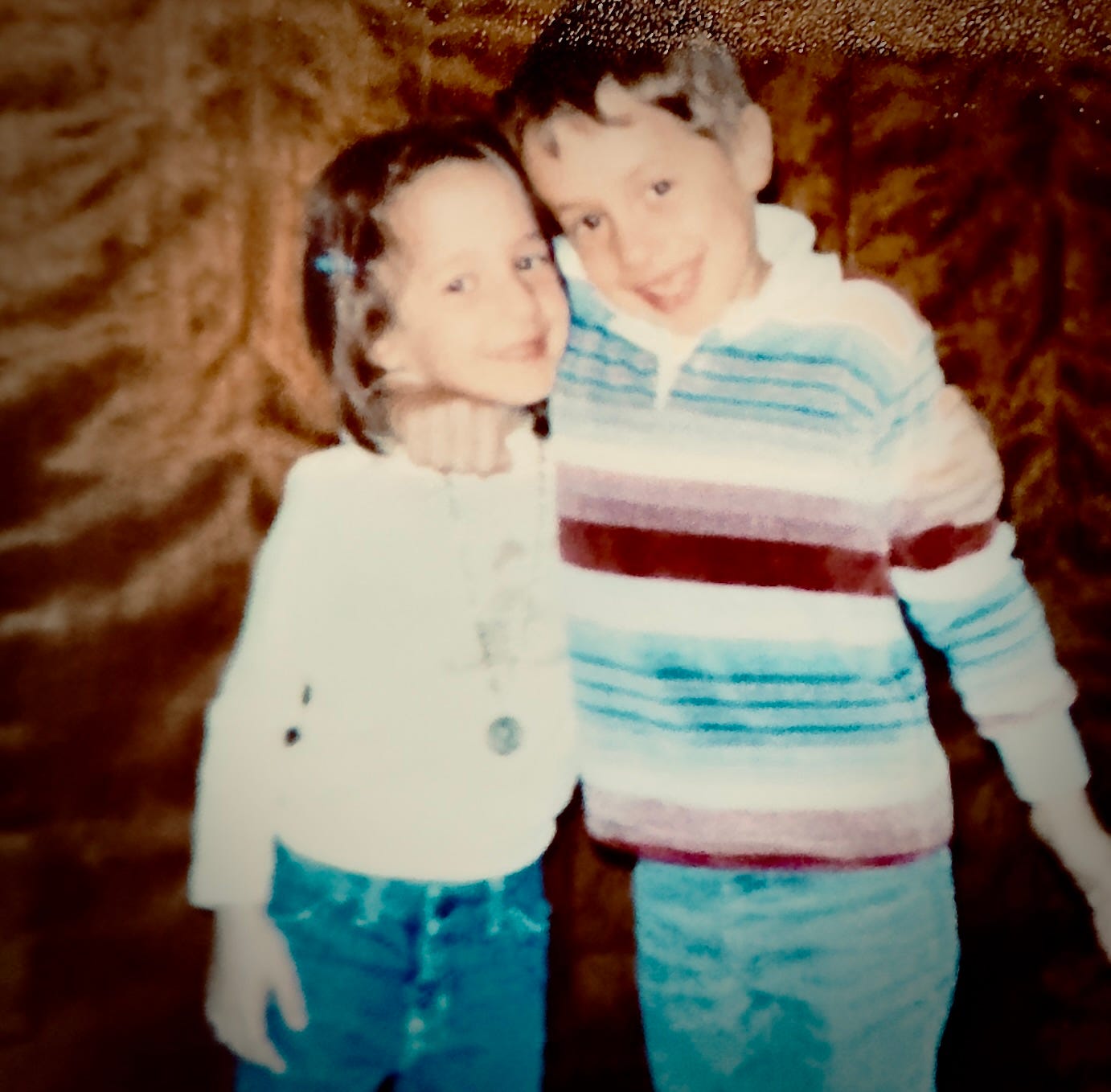
1. What happens in your body before you answer the question about your sibling?
Many surviving siblings, like my recent podcast guest and author Anne Pinkerton, have been asked “were you close?” more times than we can count. Anne called it “a really strange question,” and “way too blunt a tool,” one that makes an already awkward conversation more awkward.
When someone asks me about Tony, I feel it before I find any words. I feel myself pause and my eyes take a quick scan of who is asking and why. I use those reactions to assess how much of him and our relationship I am willing to hand over in that particular moment.
Write about that physical moment, the one that comes before the answer to the question. Do you pause, take a deep breath, scan the room, feel your heart drop, or something else? Where do you feel it? What is your body deciding and your brain assessing before you speak?
🐺
2. What does ‘close’ even mean?
When Anne and I kept circling the word, I realized something. ‘Close’ is a vague word. Look it up on Merriam-Webster, and you will find it is a verb, an adjective, an adverb, and two different nouns, with dozens of meanings between them. Even the one we mean, ‘intimate, familiar,’ sits on a list next to ‘near in distance,’ ‘stingy,’ ‘stuffy,’ and ‘secluded, secretive.’ We are handed a blurry word and asked to give a precise answer.
Tony and I were close, but not in a way that the dictionary, or the people asking, could measure. Not too ‘near in space’ as we lived over 20 miles apart, or as Pittsburghers like to confuse time with distance, an hour away. We were sometimes but not always ‘in frequent contact.’ Over time and circumstances, the contact waxed and waned. Yet, unmistakably, we were always ‘intimate’ and ‘familiar’ as the people who knew each other first. Sometimes that meant we could argue or bicker and seem to be ‘secluded, secretive’ while also having an underlying love and warmth.
So write your own definition. When you say you were close to your sibling, or that you weren’t, or that it is complicated, what do you actually mean? What kind of close were you? And which of the dictionary’s meanings has nothing to do with the bond you are trying to describe?
🐺
3. What do you wish people would ask you instead?
When people ask Anne what to say if not “were you close,” she tells them to ask the person’s name, and to ask what they were like. I would add one more: tell me about your relationship.
None of these ask you to rank anything or fit your relationship into some vague, unmeasurable concept. They are open-ended questions that just make room for you to answer in the way that you can and need to in the moment. The answer may be one thing today and another tomorrow. And yes, even when asked my brother’s name, I usually say Tony, but with some people I trust them with other names or nicknames he had.
If someone really wanted to understand my relationship with Tony, I would want them to ask me something that let me tell a story, not score a closeness on a scale of one to ten.
So write the question you wish people would ask. What question would actually let you say something true about your sibling and your relationship in the way that you need?
If you want to go further, answer your own question, the way you wish you could answer it out loud.
🐺
That is all for today. Take what is useful. Leave what is not.
If you write to any of these and want to share, the comments are open.
If these landed, there is more. The paid set this week, Wild Sibling Grief Prompts: Everything the Question Misses, takes the work deeper, nine prompts to move through at your own pace. For paid subscribers.
Warmly,
Angela
Tony’s little sister 🐺
Register for our inaugural book club, Tony’s Corner, in which we are reading Brilliant Disguise by Susan Kellam. Please join us even if you have not yet read the book.
The Broken Pack: Stories of Sibling Loss is available wherever you listen to podcasts.
Follow us on Instagram
Wild Grief is written by Dr. Angela Dean, PsyD, FT, GTMR (psychologist, thanatologist, and Tony’s surviving sibling). Interactions with The Broken Pack, LLC, Dr. Angela Dean, and its content do not constitute a therapeutic or professional psychological relationship with Dr. Dean. All content is educational and informational, not clinical advice. If you or someone you know is in crisis, please reach out to your local crisis line or warm line, or visit findahelpline.com.
Wild Grief is original work by Dr. Angela Dean and is protected by copyright. You are welcome to share posts via link. Please do not copy, reproduce, or republish content elsewhere without written permission. Certain resources from The Broken Pack, including A Surviving Sibling’s Bill of Rights, are separately released under Creative Commons (CC BY-NC-ND 4.0) and may be shared in full, with attribution, for non-commercial use. Those resources will say so explicitly.
Wild Grief is a reader-supported publication. To receive new posts and support my work, consider becoming a free or paid subscriber.
Hi Angela. I'm glad I found your publication. May I link to this article? I've curated an Anthology around Bereavement and Grief and want to ensure I include articles and resources around Sibling Grief. I lost my sister when I was very young. When you have a moment, please look around Carer Mentor: Empathy and Inspiration.